What we are
The thinking behind five small bottles.
A short account of what Elemental Scents is, why we started it, and the two long traditions we are learning from.
A short account of what Elemental Scents is, why we started it, and the two long traditions we are learning from.
Elemental Scents is a small Southeast Asian house making diffuser oils from whole essential oils — five blends, one for each of the five elements of Wu Xing, each composed around the character of its element.
Most of our time goes into the choosing. Each blend is composed using an old and well-documented way of matching plants to a person and a moment, which is the part of this we find genuinely interesting.
Every answer here is the honest one at the time. The first few are simply the ones nearest the surface.
Because that is where nearly everyone starts, us included. They were everywhere, they smelled lovely, and buying one for the atmosphere of a room felt like a small, sensible thing to do.
Because the five are a way of reading a person. Earth to stay grounded, Metal to clear, Water to be still, Wood to rise, Fire to be warm — and a reading says which one you have run light on. Scent is the quickest way to keep that element in the room, and it asks very little of you in return.
Because we kept wanting to know something the bottle could not tell us: why this plant, for this element? Not a complaint about anyone's product — plenty of them are lovely, and we still use them. Just a question that would not go away.
Because a method can be written down, checked, argued with and corrected by the next person. A mood word on a label cannot. Anything built on a method is still standing after the season that made it fashionable has passed.
Because the knowledge we are borrowing has already lasted two thousand years — and it was sitting in our own family's drawer the entire time, in the medicated oils and balms nobody thought to call a philosophy. It seemed strange to keep buying novelty while an inheritance went unused at home.
Because we would rather spend our years on something that was already worth doing than on something that is merely new.
That last one is the reason. Everything above it is just the route we took to find it.
A legend, then people whose names we can check, then the same instinct appearing again in Europe — and then, much later and much smaller, us.
The story begins with Shennong, the Divine Farmer, said to have tasted a hundred herbs one by one to learn what each did, and to have been poisoned many times over for the trouble. He is placed around 2700 BC.
He is almost certainly not a historical person. The earliest texts that mention him were written some two thousand years after he supposedly lived, and the famous herbal that carries his name was compiled later still, then attributed to him — a normal way of lending a book authority at the time.
We keep him anyway, because the legend is an accurate description of the method even if the man is a story: try a plant, watch closely, remember, and tell the next person. That is how the knowledge was actually built, by thousands of unnamed people, and the legend is how the practice remembers its own beginning.
After the legend the record becomes real, and it is remarkably continuous. In the first two centuries AD the herbal is written down: the Shennong Bencao Jing 神农本草经 — 365 entries, one for every day of the year, each noted as warming or cooling and by taste, written by unknown hands and signed with the legend’s name. Around 200 AD the physician Hua Tuo 华佗 is recorded operating with a herbal anaesthetic, and Zhang Zhongjing 张仲景 writes formulas still studied across East Asia today.
In the 600s Sun Simiao 孙思邈, who lived past ninety, compiles the Prescriptions Worth a Thousand Gold and leaves behind the sentence this whole brand rests on: read the person before you reach for the plant. Nine centuries later Li Shizhen 李时珍 spends twenty-seven years walking and writing the Bencao Gangmu — nearly 1,900 entries, with a good deal of received wisdom corrected along the way.
Running alongside the plants was the organising idea: 五行 — wǔ xíng, the five movements. There is no single inventor. They appear in the Book of Documents, one of the oldest Chinese texts we have, and were argued into a coherent school across the Warring States period, roughly 2,300 years ago — Zou Yan 邹衍 is the name most often attached, though the ideas were already circulating. Xíng means going, walking, moving: five things the world keeps doing, not five substances it is made of.
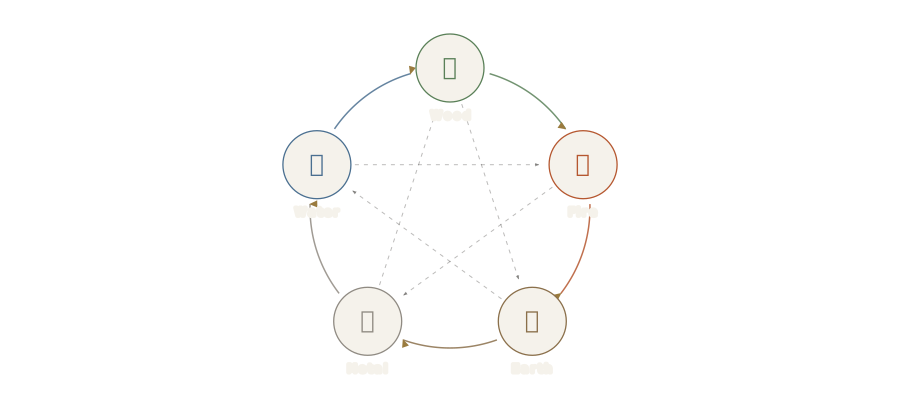
Flavour was the join between the two halves — sour with Wood, bitter with Fire, sweet with Earth, sharp with Metal, salty with Water — which meant a plant could be chosen for the state in front of you rather than at random. That is the entire usefulness of it to us, and it is narrower than it sounds.
Pulling the aromatic part out of a plant is old too. Distillation was practised across the Persian and Arab world, and the physician Ibn Sina is generally credited with refining steam distillation about a thousand years ago — roughly where essential oils as we would recognise them begin.
The word itself is young. The French chemist René-Maurice Gattefossé coined aromathérapie in 1937, and Jean Valnet, an army surgeon, carried the practice into hospitals in the decades after. Then in the 1950s the biochemist Marguerite Maury did the part that matters most to us: she set aside one-size-fits-all formulas and blended for the individual in front of her.
Which is a striking place to arrive. A twentieth-century European biochemist and a seventh-century Chinese physician, with no connection whatsoever, both concluded that the plant should be chosen for the person. We did not discover that. We are only deciding which of two very old habits to inherit.
Our part of this is modest and recent. We bought a few oils for the atmosphere of a room, like everyone else. We kept asking why a particular plant was in a particular bottle, and for which element. And then we noticed that the tradition we were looking for had been in the family drawer the whole time — in the medicated oils and balms every Southeast Asian household keeps, and nobody thinks to call a philosophy.
So we compose five blends, one for each movement, and try to be careful. We are not the next name on that list and would not pretend to be — we are just the people who decided to use what was already there, rather than invent something new to say.
One per element, and we intend to keep it at five. Each is written around the character of its element — Earth · Ground first.
We work with whole essential oils, so what is in the bottle comes from the plant itself. It costs more and it varies between batches, and we have made our peace with both.
A free birth-chart reading that suggests which of the five you have run light on — the person before the plant, in the most literal way we could build it.
Made by hand, in quantities we can actually stand behind, in Southeast Asia.
We describe the element and the scent, and we leave your body out of it — a diffuser oil is not medicine, and we would rather promise less than we deliver.
One honest note: only Earth · Ground is a finished composition today. The other four are still in research, and their cards say so — the moment, not a formula, until the work is done.
The reading takes a minute, and it runs on the oldest rule in the whole story.
Find your element